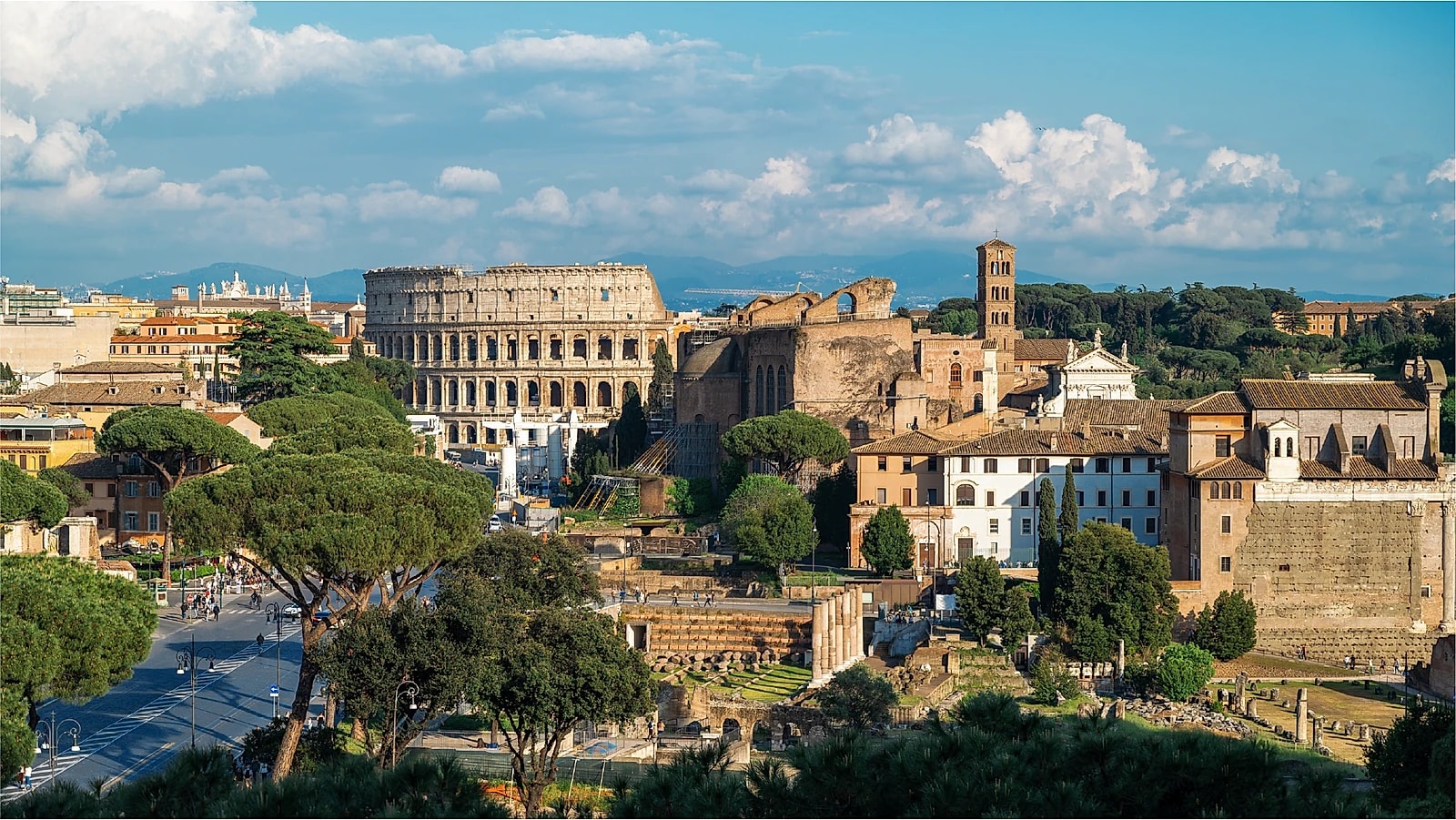
ROME & SURROUNDINGS
The Eternal City • Ancient History • Art • Food • Day Trips
Welcome to Rome
Rome is not just a city — it is a journey through time. Founded, according to legend, in 753 BC, Italy's capital offers layer upon layer of history on every street: ancient Roman temples standing alongside Baroque churches, bustling piazzas with magnificent fountains, and narrow-terraced restaurants where fresh pasta is made every morning. No two visits are ever the same, and Rome never grows old.
This guide gives you everything you need — from iconic landmarks to hidden gems, from practical tips to the best day trips from the city. Take your time and savour every moment: Rome is meant to be experienced, not rushed.
Practical Information
Getting There
By Air: Leonardo da Vinci International Airport (FCO) is the largest in Italy, located ~30 km from the city centre. Ciampino Airport (CIA) serves most low-cost carriers.
Train from the Airport: The Leonardo Express (FCO to Roma Termini) takes 14 minutes, runs every 30 minutes, and costs €14. The cheaper FL1 regional train costs €8 but takes longer.
By Car: Not recommended in the historic centre. The ZTL (Limited Traffic Zone) generates automatic fines for unauthorised vehicles.
Best Time to Visit
Spring (March–May): Pleasant temperatures (15–22°C), fewer crowds than summer, flowers in bloom — perfect for walking.
Autumn (September–November): Golden light, shorter queues, ideal temperatures for sitting on terraces.
Summer (June–August): Hot and crowded, but vibrant. Avoid July–August if you can't handle 35°C and massive queues.
Getting Around the City
Metro: 3 lines (A, B, C). Limited coverage in the centre, but useful for longer distances. Ticket: €1.50/ride or daily pass €7.
Bus & Tram: Dense network in the centre. Always validate your ticket upon boarding — inspections are frequent.
On Foot: The best way to explore the historic centre! Most major sights are within walking distance. Wear comfortable shoes and expect cobblestones.
Must-See Sights in Rome
The Colosseum & Roman Forum
Rome's most iconic symbol, the Colosseum once hosted gladiatorial contests and public spectacles for 50,000 spectators. Book tickets online at least 2 weeks in advance — queues at the door can take hours. Entry includes the Roman Forum and the Palatine Hill, where you can easily spend a full day.
Tip: Arrive at opening time (9:00 AM) for the best light for photos and the smallest crowds.
Ticket price: ~€16 (includes Forum and Palatine). Free for EU citizens under 18.
Vatican City — Museums & St Peter's Basilica
Vatican City is a destination in its own right. The Sistine Chapel with Michelangelo's frescoes is one of the most moving places on earth. St Peter's Basilica, whose dome was also designed by Michelangelo, offers one of Rome's most spectacular panoramas from the top.
Advance booking essential: Vatican Museums sell out fast. Book on the official Vatican website.
Dress code: Shoulders and knees must be covered to enter both the Basilica and the Museums.
Trevi Fountain
The world's most spectacular Baroque fountain, the Trevi Fountain is magical at any hour. Tradition says that tossing a coin over your shoulder guarantees a return to Rome. Visit early in the morning (before 8:00 AM) for the perfect crowd-free photo.
Nearby: Gelato at Della Palma (2 minutes away) — one of the best gelaterias in the area.
The Pantheon
Built in 27 BC and rebuilt by Hadrian around 125 AD, the Pantheon is Rome's best-preserved ancient monument. Its dome with an open oculus at the top remains an engineering masterpiece that inspired Renaissance architects for centuries. Since 2023, admission is charged (€5).
Bonus: Piazza della Rotonda in front of the Pantheon is perfect for an espresso at one of the surrounding cafes.
Piazza Navona & Trastevere
Piazza Navona, home to Bernini's Fountain of the Four Rivers, is the Baroque heart of Rome. In the evenings, street artists and terrace cafes create an unforgettable atmosphere. A 15-minute walk away, the cobblestoned neighbourhood of Trastevere with its winding lanes and traditional trattorias is the perfect spot for dinner.
Food & Drink: What and Where to Eat
Traditional Roman Dishes
Cacio e Pepe — pasta with pecorino romano and black pepper. Deceptively simple, extraordinary when done right.
Carbonara — pasta with guanciale (cured pork cheek), egg, pecorino and pepper. No cream! The authentic recipe never includes it.
Amatriciana — pasta with tomato sauce, guanciale and pecorino. Originally from Amatrice but wholeheartedly adopted by Romans.
Suppli — fried rice balls filled with tomato sauce and mozzarella. The quintessential Roman street food.
Gelato artigianale — choose gelaterias where fruit flavours look opaque (not fluorescent) and the gelato is stored in covered metal pans.
Restaurant Tips
Avoid restaurants with menus in 10 languages, photos on the menu, and waiters calling out to you from the doorway — these are usually tourist traps.
Look for places with an Italian-only menu (or a discreet translation) and locals eating lunch.
Coperto (table cover charge) of €1–3 per person is standard across Italy — it is not a scam.
Lunch (12:30–14:30) is cheaper than dinner at the same restaurants. Take advantage of this!
Day Trips from Rome
Tivoli — Imperial Villas (30 km East)
Just 30 minutes by train from Roma Tiburtina, Tivoli is a double UNESCO World Heritage destination: Villa d'Este with its spectacular gardens of hundreds of fountains, and Villa Adriana — Hadrian's imperial complex and the largest Roman villa complex in the world.
Getting there: Train from Roma Tiburtina (RegioExpress) — ~35 min, €3.20. Then local bus to the villas.
Recommended: Visit Villa Adriana in the morning and Villa d'Este in the afternoon. End with an aperitivo in the central piazza.
Ostia Antica — Rome's Own Pompeii (25 km West)
The former port metropolis of ancient Rome, Ostia Antica is less visited than Pompeii but equally impressive — and without the flight to Naples. The ruins include thermal baths, temples, intact mosaics and even an amphitheatre that hosts outdoor concerts in summer.
Getting there: Metro line B to Piramide, then local Ostia train (~30 min total, €1.50 with metro ticket).
Tip: Bring water and snacks — the park's canteen is pricey. Allow at least 4 hours for a relaxed visit.
Orvieto — Umbria's Hidden Gem (90 km North)
Dramatically perched on a volcanic plateau, the medieval city of Orvieto is home to one of Italy's most beautiful Gothic cathedrals — the Duomo di Orvieto with its gilded facade. The town is also celebrated for its Classico DOC wine and traditional Umbrian cuisine.
Getting there: Train from Roma Termini (~1h15, €9–15) + funicular from the station into town (included in local ticket).
Don't miss: Pozzo di San Patrizio — a 53-metre-deep double-helix well, an extraordinary feat of 16th-century engineering.
Naples & Pompeii (220 km South)
An intense but unforgettable day: the Frecciarossa high-speed train covers the Rome–Naples distance in just 70 minutes. Spend the morning at Pompeii (allow 3–4 hours), enjoy an authentic Neapolitan pizza for lunch (Naples is the birthplace of pizza!), and explore Naples' historic centre in the afternoon.
Getting there: Frecciarossa from Roma Termini to Napoli Centrale (~70 min, from €19 with advance booking).
Recommended departure: 7:30 AM from Rome to reach Pompeii before 10:00 AM and beat the tour groups.
Civita di Bagnoregio — The Dying Town (120 km North-West)
Known as "il paese che muore" (the town that is dying), Civita di Bagnoregio is a medieval village perched on a tufa rock pinnacle and accessible only via a stone footbridge. The landscape is surreal, like something out of a Renaissance painting. Fewer than 10 people live here permanently, yet the experience is unlike anywhere else on earth.
Getting there: By car ~1h30 (recommended) or bus from Roma Termini with a change at Orvieto. Bridge toll: €5.
Suggested Itinerary: 5 Days in Rome
Day 1 — Ancient Rome
Morning: Colosseum, Roman Forum, Palatine Hill. Lunch in Testaccio (the local food market). Afternoon: Circus Maximus, the Aventine Hill with the Knights of Malta Garden and its famous keyhole view of St Peter's dome. Evening: Aperitivo in Trastevere followed by dinner at a local osteria.
Day 2 — The Vatican & Castel Sant'Angelo
Early morning (7:30 AM): Vatican Museums and Sistine Chapel (pre-booked tickets essential!). Lunch in Borgo Pio (near Vatican). Afternoon: St Peter's Basilica + climb the dome. Evening: Stroll along the Lungotevere, the illuminated Castel Sant'Angelo, dinner in the Prati neighbourhood.
Day 3 — Baroque Rome
Morning: Trevi Fountain (early!), Pantheon, Piazza della Rotonda. Lunch near Navona. Afternoon: Piazza Navona, Campo de' Fiori, Palazzo Farnese. Evening: Concert or opera (check Opera di Roma or summer open-air concerts for programme).
Day 4 — Day Trip to Tivoli or Ostia Antica
A full day for one of the recommended day trips. On your return, spend the evening in the Testaccio or Ostiense neighbourhoods for a more authentic, less touristy dining and nightlife experience.
Day 5 — Neighbourhoods & Markets
Morning: Porta Portese market (Sundays) or Campo de' Fiori market. Stroll through Monti (Rome's hippest neighbourhood). Lunch with pizza al taglio (by the slice). Afternoon: Galleria Borghese (booking essential!) with its breathtaking collection of Bernini sculptures and Caravaggio paintings. Evening: Farewell dinner on a restaurant terrace with a view of the Eternal City.
Essential Travel Tips
Free drinking water: Rome has over 2,500 nasoni (public drinking fountains) with cold, clean water. Bring a reusable bottle.
Roma Pass: 48h card (€32) or 72h card (€52) — includes public transport and museum discounts. Worth it if you plan to visit many attractions.
Watch out for pickpockets: High-risk areas include the Colosseum, the metro, and Trevi Fountain. Keep your bag in front of you.
No eating near monuments: Fines of up to €400 apply for picnicking in protected areas (including the steps in front of the Pantheon).
Book ahead: The Colosseum, Vatican Museums and Galleria Borghese all require online booking. In high season, book 2–3 weeks in advance.
Espresso vs. cappuccino: Italians only drink cappuccino in the morning. Espresso comes after meals. Ordering a cappuccino after lunch will earn you an amused look from the locals.
"Rome is not seen — Rome is lived."