Moscow and Saint Petersburg are often seen through clichés — but there’s so much more to them.
This journey takes you beyond the obvious, into two of the world’s most fascinating cities.
Throughout the article — and in dedicated photo galleries at the end — you can explore my personal photo selection from both Moscow and Saint Petersburg.
In short, the article covers:
My overall impressions of Saint Petersburg and Moscow
The challenges of border crossing and getting there
The local price levels and everyday costs
And, in the next stage, I will expand the article with personal experiences and additional photos
Photo gallery at the end of the article
The Hermitage Museum – views from the outside and inside, showcasing the grandeur and art collections.
Nevsky Prospect – the bustling main avenue of Saint Petersburg, full of life and architecture.
Moscow Metro stations – famous for their beautiful design and ornate interiors.
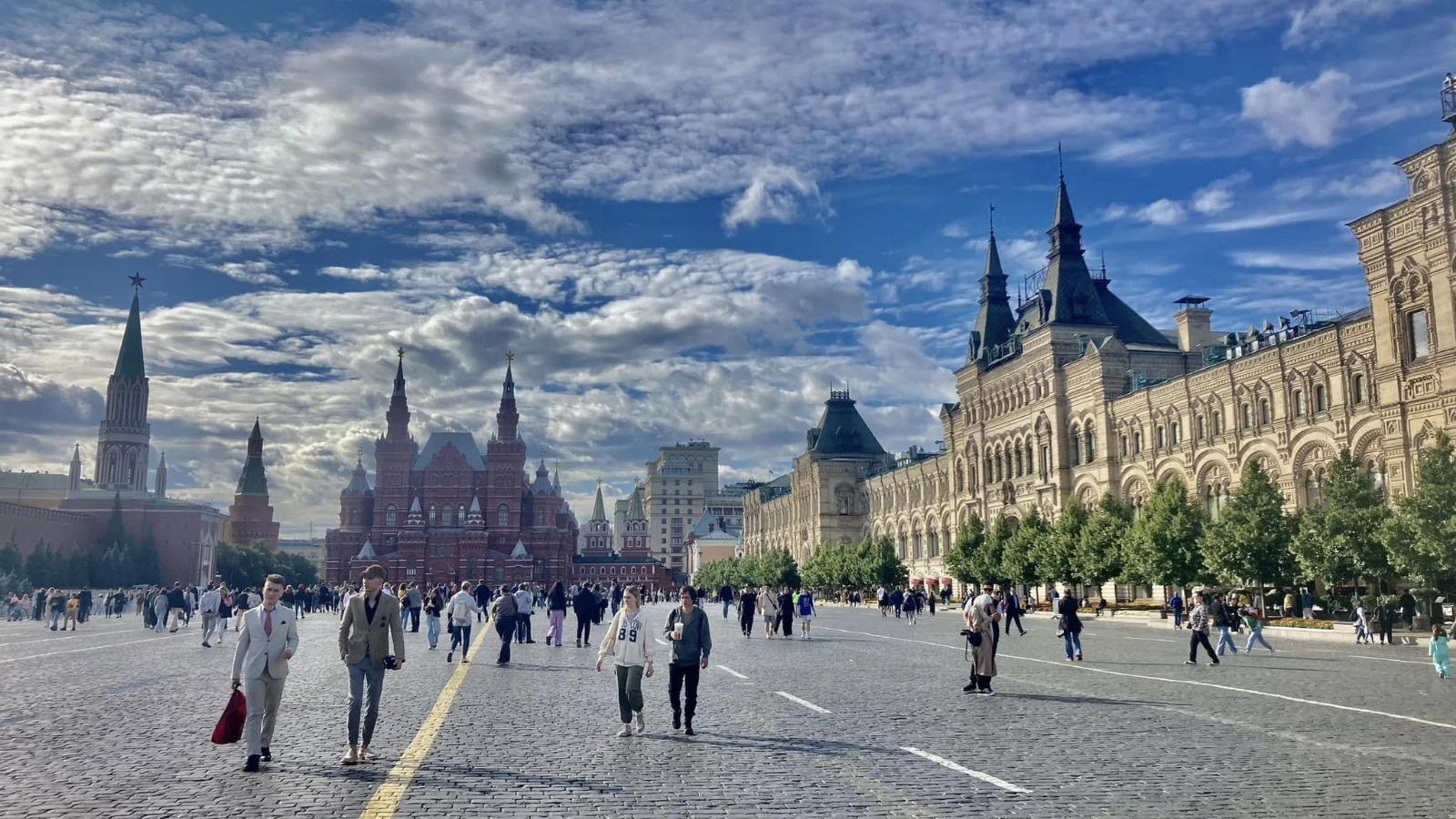
Inside the Kremlin walls – sights within the Kremlin, including landmarks, squares, and historic buildings.
Our itinerary was as follows:
We flew to Estonia on Saturday, August 30. We arrived in the early afternoon and even had time for a swim in the Baltic Sea. Probably no surprise here — by that time of year, the beach was far from crowded.
We arrived early on purpose, so that on Sunday, the 31st, we could travel the Tallinn – Narva – Ivangorod – Saint Petersburg route and cross the border. This plan left us with one full evening in Saint Petersburg.
We spent two full days and a third morning in Saint Petersburg. During those two days, we explored the city mostly on foot, visited the Hermitage Museum, and made a trip to Peterhof, often referred to as the “Versailles of the North” — and, without any bias, I dare say it’s even better.
On that third morning, we traveled to Moscow by high-speed train. We arrived in time for lunch and had another two and a half days to explore this beautiful city. I planned the itinerary so that on our last evening in Moscow, we would travel back by overnight train. I’ll write more about that experience later — because it was absolutely incredible, especially in hindsight.
We arrived back in Saint Petersburg early in the morning by night train, then immediately continued by bus to Tallinn, where we spent the night. And here comes the twist.
The journey wasn’t over yet. I like to complicate things a little. Instead of heading straight home from Tallinn, on September 6, early in the morning, we crossed the Gulf of Finland on a massive cruise ship and arrived in Helsinki. We spent the entire day there, explored Finland as well, and by the end of the day, this truly unique journey came to an end.
So yes — four cities, three countries, in just a few days.
I’m always happy to help others plan similarly rich, experience-filled trips… but more on that later.
Enjoy the pictures! I continue the story after them.


First and most important: where did the idea come from — and how was it even possible?
Due to the ongoing armed conflict, entering Russia has become significantly more difficult, but not impossible. The challenges can be overcome.
Thanks to my professional background and personal network, I had the opportunity to get to know Russian citizens living in Budapest. They helped me with incredible dedication and genuine enthusiasm. They were happy to talk about their country, share detailed insights, show photos on their phones, call relatives back home, and carefully double- and triple-check every single booking.
In fact, their local connections were the key to entering the country and making this journey possible.
To legally enter and visit Russia, a valid passport and visa are required. However, the visa must include confirmed accommodation details. And this is where the main obstacle appears: from Hungary — and generally from the EU — it is not possible to pay or book services in Russia using non-Russian bank cards or accounts, either online or in person.
This completely rules out making a simple accommodation booking from home, for example via platforms like Booking.com. This is exactly where having a trusted Russian contact becomes essential. You have to commit in advance, stay optimistic about the trip, and pre-book accommodation ahead of time.
A short detour: where can you book accommodation?
The answer is Yandex Travel.
In Russia, Google is not the primary search engine — in fact, it doesn’t really work at all. The dominant platform is Yandex, which also offers a range of specialized services, such as Yandex Taxi.
Fortunately, Yandex Travel is accessible from abroad, including from Hungary. This allowed me to select and arrange accommodation in advance. The platform proved to be reliable — we received exactly what was shown in the descriptions and photos.


In the end, my Russian contact also helped me finalize the accommodation booking. It was processed and confirmed almost immediately, which allowed me to include it in the visa application without delay.
As for the visa itself, the process was surprisingly fast. The approval took no more than four days, weekends included. With that done, most of the paperwork was finally behind us. However, two important things were still missing:
A local SIM card and a bank card.
It’s important to know that roaming in Russia is outrageously expensive. If I were to convert the costs, sending a single photo — for example, to show a friend that I’m standing next to the walls of the Kremlin — would easily cost the equivalent of two restaurant lunches back home.

SIM card
Arranging a local SIM card was essential — but these days, it’s far from simple in Russia. You can’t just walk into a shop, an airport kiosk, or even a provider’s store and buy one like you would in most other countries (especially within the EU).
Once again, I needed the help of my Russian contacts. After several days of email communication with the mobile provider’s customer service, we finally managed to schedule an appointment for the morning after our first night in the country. Imagine this: for nearly an entire day, we had no way to contact the outside world at all.
At the agreed time, a representative from the provider arrived in person. They took fingerprints, checked all of our documents, and only after that were we issued the SIM cards. From that moment on, we were officially back on the map.
Money
Since we couldn’t use our own bank cards in Russia, this also required careful preparation. Back in Hungary, we calculated our expected expenses in advance and brought exactly the amount of foreign currency we thought we would need.
In practice, the money we carried with us was all we had for the seven days in the country — so budgeting was essential.
I exchanged both US dollars and Russian rubles, both of which are available in Hungary. When it comes to US dollars, however, not just any banknotes are accepted: only bills issued after 2013, and they must be in perfect condition, without certain marks or damage — otherwise they may be refused. Unfortunately, we experienced this firsthand. Luckily, as any seasoned traveler knows, it’s always wise to exchange a little more than you think you’ll need, so it didn’t cause any real trouble.
Everything was in place. Everything worked out.
Time to start exploring the country.


My first impressions of Russia and the Russian people
I had heard many stories about Russians before, and since I already knew a few personally (for better or worse), not everything was completely new.
At the Narva–Ivangorod border crossing, we queued with about 50–60 Russians. It quickly became clear that we weren’t locals. Although very few of them spoke English, they used their translator app — Yandex Translate, which I found surprisingly good, far better than Google Translate — to communicate with us. They immediately checked that we didn’t have Euros or any other foreign currency except for pounds, US dollars, or rubles. I still had a few thousand Hungarian forints in cash, which they actually exchanged for rubles right there in Narva! From the very beginning, people were friendly and helpful.
At the Russian border, while waiting in line, I received a stamp in my passport. Along with it, the border officer attached a migration card. Even then, people approached us, using their phones to warn us: “Take great care of this!” I think very few nations show such genuine concern for foreign visitors.
Once we crossed the border, past all the tank traps and checkpoints, we had a short walk of about 600–700 meters in Ivangorod to reach the bus waiting for us. On that walk, we immediately ran into a residential block (what else?). At the base of the building, squeezed between parked cars, stood a memorial — a tank. It was a striking first sight, instantly putting us in the right mood for our Russian adventure.

Arriving in Saint Petersburg
As we reached the outer districts of Saint Petersburg, it was already clear that this city was going to be stunning. Unfortunately, I don’t have any really good photos from this moment — we arrived in twilight after a full day of traveling, and all my shots were taken through the bus window. Even so, the boulevards, highways, and buildings were impressive enough to leave a strong first impression.
Once we arrived, the group was hungry. Right next to the bus stop, we found a gyro place. There, I had a shawarma — in Moscow, the same dish was called shaorma. I won’t over-explain; I’ll just attach a photo.
The total cost? About 5 EUR in rubles — not bad for a first snack in the city!

How the country has changed since the war
First, let me be clear: in everyday life, the daily rhythm of the two major cities has hardly changed. People are out on the streets, dancing, shopping, and going about their lives. Shops are well-stocked, and you can find almost everything you would expect at home.
On weekday evenings, the streets come alive. Long lines form outside the operas, and musicians play in nearly every subway station. Life goes on, vibrant and full of energy, despite the headlines.

Prices, public transport, and style
Prices have dropped significantly in recent years. The decline in tourism, combined with a weakened ruble, made the city surprisingly friendly for Hungarian wallets. Every service provider operates at noticeably lower rates than before. I’ll share more detailed insights on the local cost of living at the end of the article.
Public transport is crowded, always full. Even though trains run every 40 seconds, we still had to wait four or five times before we could board.
I also have to mention that Russians are exceptionally well-dressed across all age groups. Their taste is impressive, and people wear high-quality clothing with style.


Overnight train from Moscow back to Saint Petersburg
We chose this option not only out of curiosity but also for better time management.


What are Russians like as hosts?
Absolutely brilliant! Extremely friendly — these encounters were among my favorite moments of the entire trip.
Earlier in the show, I shared two previous examples: one from an evening in Saint Petersburg and another from a quiz night invitation in Moscow. Here, I’d like to tell two more stories related to Russian hospitality.

An unforgettable evening in a Moscow pub
And now, let me tell you about an even more memorable experience — one that took place in a cozy Moscow pub. Visiting local bars is part of the travel experience, and we didn’t need to be asked twice. We found a spot, and it wasn’t long before two Russian men approached us. To our pleasant surprise, they spoke English. The usual questions followed: Who are we? What are we doing here? Why come now, when so few people visit?
Once we answered, the pub closed, and a decision had to be made: where next? They promised to cover our drinks for the evening — as long as we stayed with them. So, we walked together to two more bars, passing the Red Square along the way. I was surprised to see it closed at night, as it was being cleaned — the surrounding streets were too!
The rest of the evening was filled with conversation. We didn’t fight, we didn’t get drunk, yet the night was full of insights. We touched on many topics, mainly how ordinary Russians feel powerless under the system and uneasy in their own country. The countryside is poor, while cities are deliberately kept in better condition.
Their drinking culture was fascinating. After some beer, we switched exclusively to vodka, but every shot was accompanied by a glass of water, which meant the nearly eight-hour evening ended without any side effects. I realized that Hungarians often drink to forget, whereas Russians drink as part of culture and enjoyment, though certainly more intensely (with due respect to exceptions).
Throughout the evening, they were constantly grateful. Finally, foreigners — finally, visitors. Since the 2018 World Cup, the country has been somewhat isolated from the world. Back then, the streets were impassable, yet now we walked them alone in broad daylight. The people clearly miss the buzz of the wider world.
Finally
I want to showcase everything that was truly eye-catching. I won’t go into a long description here — each photo is accompanied by the necessary captions and information, so it’s clear and obvious what you’re seeing.
Photo gallery
The Hermitage Museum – views from the outside and inside, showcasing the grandeur and art collections.
Nevsky Prospect – the bustling main avenue of Saint Petersburg, full of life and architecture.
Moscow Metro stations – famous for their beautiful design and ornate interiors.
Inside the Kremlin walls – sights within the Kremlin, including landmarks, squares, and historic buildings.


